Your POA Is Worthless Until Someone Tries to Use It
You signed the form. Your daughter drove to the credit union with the mortgage payment and a notarized copy. The branch manager looked at it, called the compliance department, and came back with: "We can't accept this."
Not "bring us more documentation." Not "let us verify." Just no.
This happens in Ohio more than almost anywhere else in the country. When Ohio adopted the Uniform Power of Attorney Act, the legislature deliberately omitted Sections 119 and 120 — the provisions that penalize banks for unreasonably refusing valid documents. Without those provisions, Ohio financial institutions face liability if they honor a fraudulent POA but face zero consequences if they reject a perfectly legal one. Every branch manager's incentive is to refuse.
The Ohio Power of Attorney Kit exists because a document that can't survive the bank lobby isn't a plan — it's a false sense of security.
The Ohio Compliance System
Most POA kits hand you forms and wish you luck. This one was built around a different question: what actually happens when your agent walks into a branch on a Tuesday morning with your power of attorney and a stack of overdue bills?
The answer, for most Ohio families, is rejection. And unlike 40+ other states, Ohio law gives you no statutory remedy when it happens.
The kit includes a complete Bank Acceptance Toolkit built on the two strongest tools Ohio law provides:
- The R.C. 1337.60 Statutory Form — the official Ohio template that financial institutions are most familiar with and least likely to reject on sight
- The R.C. 1337.61 Agent's Certification — a sworn affidavit your agent presents to formally verify the POA's current validity, shifting the compliance burden onto the institution
- Signing protocol — the exact notary acknowledgment steps that eliminate the "defective execution" excuse banks rely on to stall
When your agent presents the certification form, the bank's calculation changes. They're no longer choosing whether to help — they're weighing whether a documented refusal of a certified statutory form creates exposure they don't want.
What's Inside the Kit
The kit includes 9 printable PDFs — a complete 16-chapter guide, a quick-start checklist, and 7 standalone worksheets you can print and bring to the bank, the notary, or the closing table:
- Complete 16-Chapter Guide (52 pages) — covers financial POA, healthcare directives, hot powers, bank acceptance strategy, dower rights, springing vs. immediate powers, Transfer on Death coordination, Medicaid estate recovery, probate tier thresholds, revocation procedures, and elder abuse protections
- Hot Powers Decision Guide — R.C. 1337.42 requires individual initialing for high-risk powers like gifting, trust amendments, and beneficiary changes. The guide walks you through each one so you grant exactly what you intend and nothing more
- Bank Acceptance Toolkit — the R.C. 1337.60 statutory form, the R.C. 1337.61 Agent's Certification, and the step-by-step protocol for handling branch-level resistance
- Real Estate Transaction Guide — dower release procedures under Chapter 2103, county recorder filing requirements, and how to execute deeds under a POA when you can't attend the closing
- Medicaid Estate Recovery Analysis — how Ohio's expanded estate definition (R.C. 5162.21) reaches TOD transfers, joint tenancy, and revocable trusts — the trap that catches families who think probate avoidance means asset protection
- Healthcare Directive Protocol — witness eligibility rules under R.C. 1337.12(B), living will declarations under Chapter 2133, and guardian nomination under R.C. 1337.28
- Revocation Forms and Notification Templates — pre-drafted revocation documents, notification letters for financial institutions, and county recorder filing instructions under R.C. 1337.05
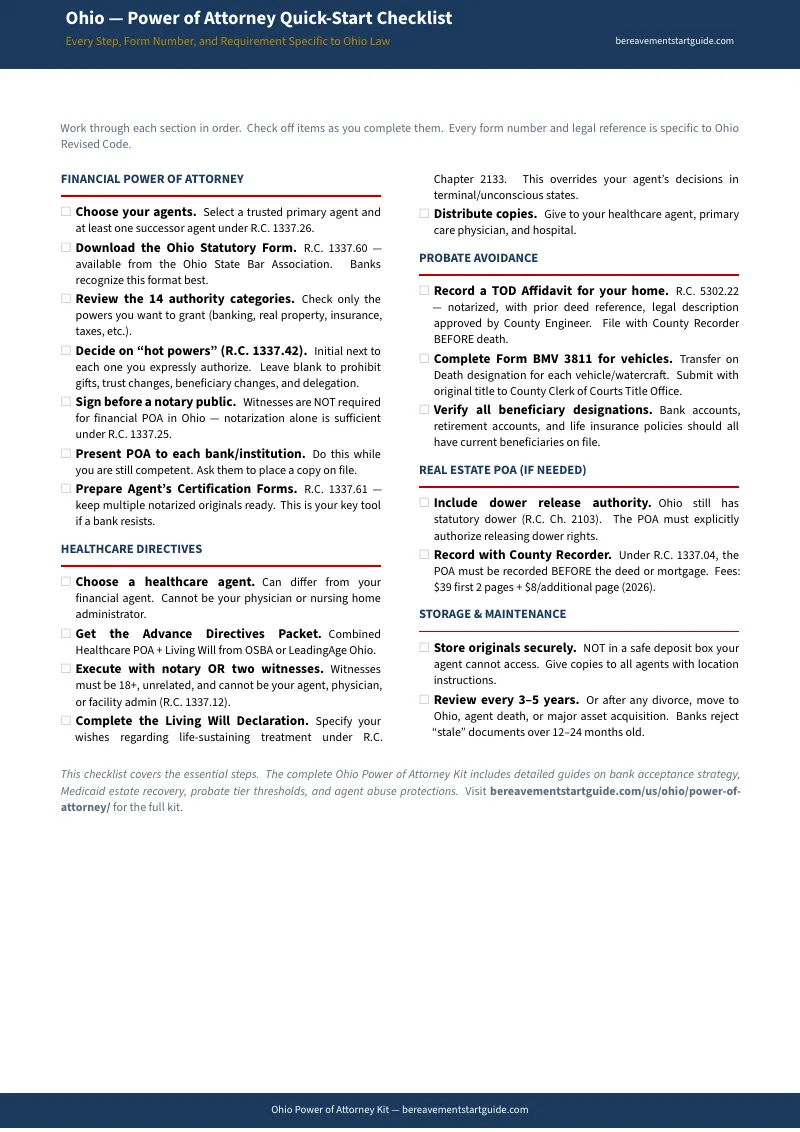
- Quick-Start Checklist (free version available) — the essential steps to get your POA executed correctly, with Ohio-specific notary and witness requirements
Who This Kit Is For
- Adult children managing aging parents — you've noticed the missed bills, the confusion at the pharmacy, the repeat questions about accounts they've managed for forty years. You need legal authority to step in before a parent loses the "sound mind" capacity required under R.C. 1337.25 — because after that, your only option is probate court guardianship.
- Ohio homeowners — your property is subject to statutory dower rights that surprise most families. If you can't attend a closing, if you're deploying out of state, or if a non-titled spouse needs to release their dower interest, you need a recordable POA that county recorders won't reject.
- Retirees over 55 — Ohio's Medicaid Estate Recovery program uses an expanded estate definition that reaches beyond probate. Your TOD affidavit, your joint bank account, your revocable trust — all of them are potentially recoverable. The kit explains how these tools interact with your POA before you make irreversible decisions.
- Couples protecting each other — married or unmarried, you need more than assumptions. Ohio law gives spouses certain default rights, but none of them cover managing a bank account, filing taxes, or making medical decisions when your partner is unconscious in the ICU.
- Anyone preparing for surgery — anesthesia means temporary incapacity. You want healthcare preferences documented and a trusted person authorized to act if complications extend your recovery.
Why Not Use the Free Statutory Form?
The R.C. 1337.60 statutory form is free. You can download it from Pro Seniors, Ohio Legal Help, or the Ohio State Bar Association. It's also a blank sheet of legal language with zero guidance on what happens after you sign it.
Here's what the free form doesn't tell you:
- That Ohio banks routinely reject POAs they consider "stale" — even though Ohio law sets no expiration — because the state omitted the penalties that would force them to comply
- That "hot powers" like gifting and beneficiary changes require individual initials under R.C. 1337.42, and skipping them silently strips your agent of authority they might desperately need
- That a springing POA sounds safe but can delay your agent's access by weeks while a bank demands physician certifications during a crisis
- That your Transfer on Death Designation Affidavit does not protect your home from Medicaid estate recovery — and the county recorder is required to notify the state when the transfer triggers
- That real estate deeds executed under a POA must comply with R.C. 5301.01 execution standards and the POA itself must be recorded in the county before the deed — or the title company will kill the deal
The free form gives you the legal shell. This kit gives you the knowledge to make it work in the real world — and the tools to fight back when someone tries to reject it.
100% Money-Back Guarantee
If the kit doesn't meet your needs, email us at any time for a full refund. No forms, no justification required.
Get Protected Today
For , you get both a Durable Financial POA and Healthcare Directive — plus the bank acceptance tools, hot powers guide, real estate protocol, and Medicaid analysis that make them enforceable. That's less than what most notaries charge for a single acknowledgment session.
Download the free Quick-Start Checklist to see our approach, or get the complete Ohio Power of Attorney Kit and have your documents ready to sign tonight.