Your Parent Just Had a Stroke. The Bank Won't Talk to You.
The hospital calls. Your mother collapsed at the grocery store. She's stable but can't speak, can't sign, can't make decisions. You drive to the bank to pay her mortgage — and the teller says no. You're not on the account. You don't have the right paperwork.
Without a durable power of attorney, Oklahoma law treats you like a stranger to your own parent's finances. The only path forward is court-appointed guardianship: filing fees, mandatory background checks, court investigators, multiple hearings, and annual reporting — for as long as your parent lives.
A single document, signed before the crisis, prevents all of it.
The Oklahoma Legal Authority System
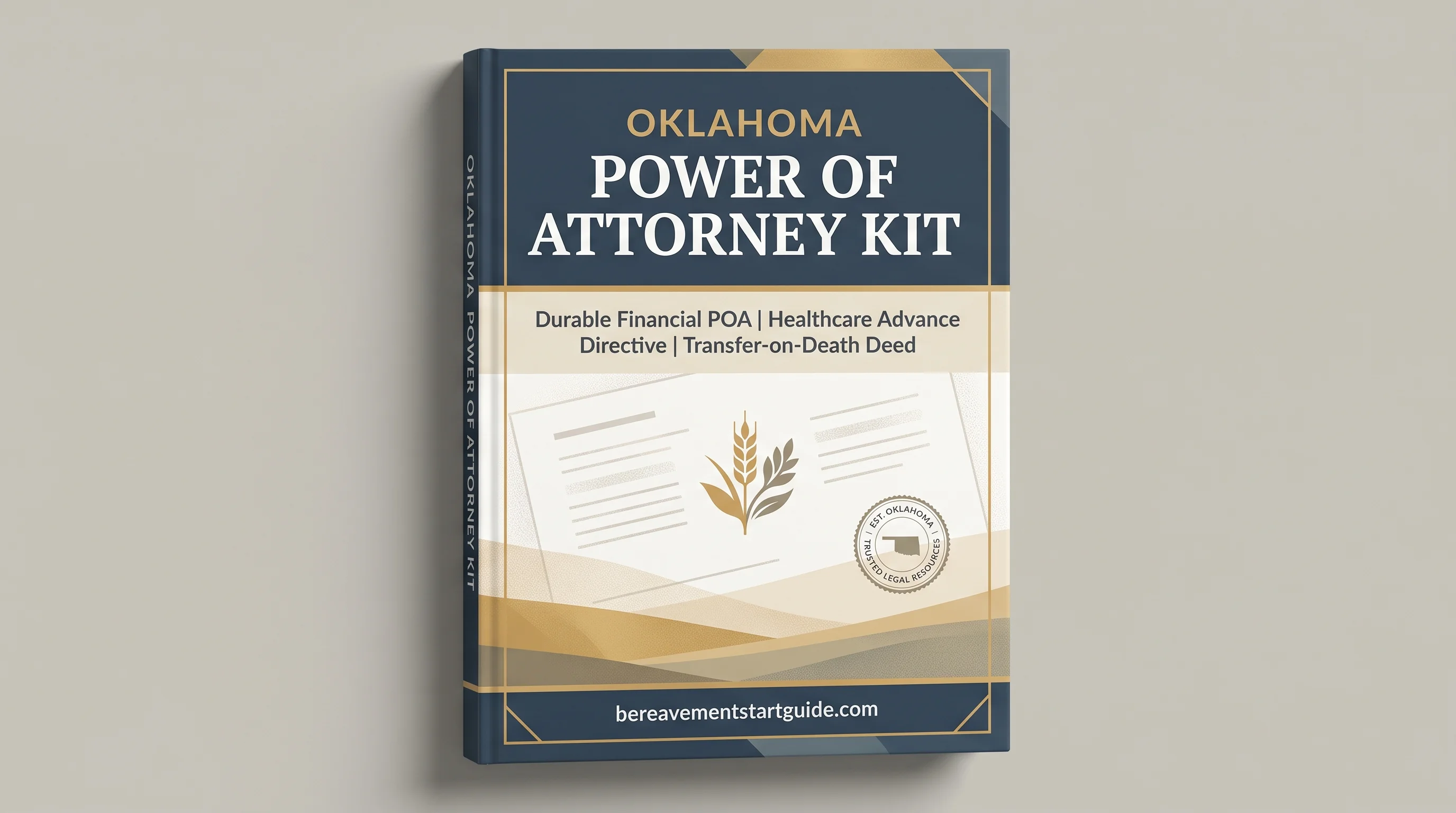
This isn't a generic form download. The Oklahoma Power of Attorney Kit is a complete legal authority system built on two separate Oklahoma statutes that most people don't realize exist — the 2021 Uniform Power of Attorney Act (Title 58) for financial decisions and the Advance Directive Act (Title 63) for healthcare. Miss the distinction and your documents have gaps that surface at the worst possible moment.
The kit gives you state-specific templates, execution checklists, and institutional acceptance protocols so every document you sign actually works — at the bank, at the hospital, at the county clerk's office, and with the title company.
What's Inside
- Durable Financial Power of Attorney — built on 58 O.S. § 3001–3045 with clear initialing options for every "hot power" (gifting, trust changes, beneficiary designations). Without explicit initialing, Oklahoma law blocks your agent from making these moves — even in an emergency.
- Combined Medical Advance Directive — the statutory form under 63 O.S. § 3101.4 that combines your healthcare proxy, living will, and anatomical gift elections in one document. Includes the specific witness requirements that differ from your financial POA.
- Transfer-on-Death Deed — formatted with the mandatory 2-inch top margin that Oklahoma county clerks require, pre-structured for real estate and mineral interests. Your home passes directly to your beneficiary without touching probate.
- Hot Powers Initialing Worksheet — a fillable decision worksheet for the nine statutory powers (58 O.S. § 3024) that are legally void unless you explicitly initial each one. Complete this before your notary visit so you know exactly which boxes to check.
- Bank Acceptance Protocol — the exact text of 58 O.S. § 3020 formatted as a printable rights card your agent hands to a branch manager. Under this statute, banks face mandatory court orders and attorney fee liability if they wrongfully refuse your notarized POA. Most tellers don't know this. Your agent will.
- Formal Revocation Template — a complete revocation form with notary block and delivery checklist, because revoking a POA means more than saying "I changed my mind" — you need written proof delivered to every institution that received the original.
- Document Execution Checklist — side-by-side comparison of execution requirements for your Financial POA, Healthcare POA, and Advance Directive. Print it and bring it to your notary appointment.
- County Clerk Recording Guide — exact margin formatting, filing fees, and the critical 9-month deadline for TODD beneficiary acceptance affidavits. Miss this window and the property reverts to probate.
- Medicaid Recovery Bypass Worksheet — a fillable asset protection audit that walks through every asset you own and whether it currently bypasses probate. Oklahoma's SoonerCare estate recovery program only reaches assets in the probate estate — this worksheet shows where the gaps are.
- Tribal & BIA Coordination Protocol — for members of the Five Civilized Tribes, Osage Nation, and other federally recognized tribes. Covers how to coordinate your state POA with Bureau of Indian Affairs requirements for restricted allotment lands, Individual Indian Money accounts, and mineral royalty distributions.
- Post-Mortem Workflow Timeline — a step-by-step checklist covering Days 1–5 death registration through the 9-month TODD acceptance deadline, with checkboxes and every critical deadline marked.
- Fees Quick Reference — all Oklahoma filing fees, recording costs, death certificate charges, and government fees on one printable page.
Who It's For
- Adult children caring for aging parents — especially if a health crisis has already happened or cognitive decline is accelerating. A durable POA now prevents a guardianship proceeding later.
- Oklahoma homeowners and landowners — anyone who wants their property to pass without probate. Oklahoma's $200,000 summary administration threshold is generous, but a TODD bypasses the courthouse entirely.
- Families with mineral interests — oil and gas royalties, severed mineral estates, and surface/subsurface splits require specific POA language and recording procedures that generic forms don't address.
- Tribal members navigating dual jurisdictions — restricted land, trust accounts, and tribal court requirements sit alongside state law. The kit maps where state authority ends and federal/tribal authority begins.
- Real estate buyers and sellers — if one party can't attend closing, the POA must be notarized, recorded in the right county, and formatted to title company standards before the deed is valid.
- Military families facing deployment — service members who need someone to handle finances, property, and healthcare decisions while they're overseas.
Why Not Free Forms?
Oklahoma's statutory POA form is free. It's on the Tulsa Public Library's website. County clerks have it. The state government publishes it.
Here's what the free form doesn't include:
- No execution checklist — it doesn't tell you that a financial POA needs notarization for institutional acceptance but a medical advance directive needs two specific witnesses instead
- No "hot powers" explanation — without initialing the right boxes on the statutory form, your agent is blocked from making gifts, changing beneficiaries, or modifying trusts, even if you intended to grant those powers
- No bank acceptance protocol — when a teller refuses your POA, the free form doesn't tell your agent about the 7-day acceptance window or the attorney fee liability under 58 O.S. § 3020
- No recording guidance — the free form doesn't mention the county clerk's 2-inch top margin requirement, the TODD's 9-month acceptance deadline, or the separate filing needed for mineral interests
- No Medicaid recovery strategy — the form doesn't explain how Oklahoma's probate-only recovery rule can protect your home if you structure your transfers correctly
The form gives you a blank page. The kit gives you the instructions that make it work.
Your Purchase Is Protected
If the kit doesn't give you clarity on setting up power of attorney in Oklahoma, email us and we'll make it right. Every template is built on current Oklahoma statutes — the 2021 UPOAA for financial powers and the Advance Directive Act for healthcare — with specific section citations so you can verify every claim.
— Less Than One Hour of Attorney Time
Oklahoma elder law attorneys charge $1,500 to $3,500 for a standard estate planning package. The kit covers the same ground for the cost of a notary visit — and unlike an attorney's office, it's available right now, at 11 PM on a Tuesday, when the hospital just called.
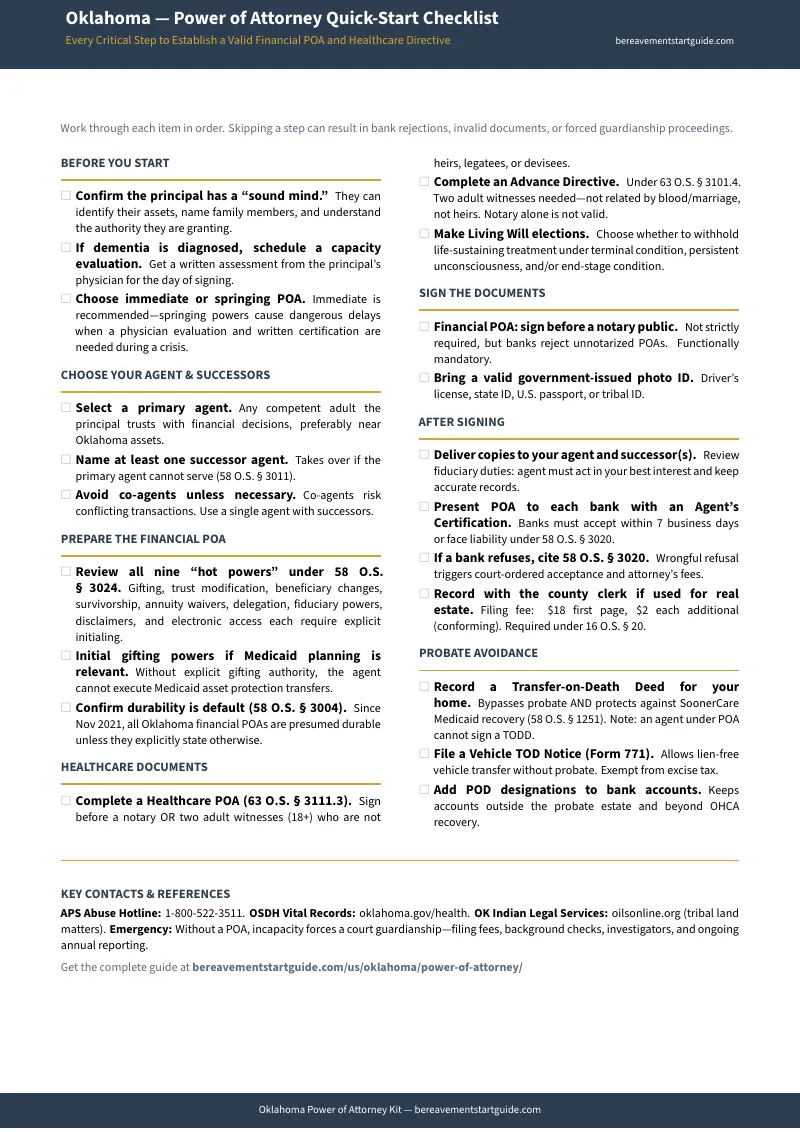
Free tier: Download the Oklahoma POA Quick-Start Checklist — a diagnostic overview of what you need, what Oklahoma law requires, and where the gaps in your current planning might be.
Full kit: Every template, execution guide, institutional acceptance protocol, and bypass strategy in one download. Fill it out tonight. Sign it tomorrow.