
Oregon Has a $1 Million Estate Tax Trap — and Most Families Walk Right Into It
You own a home in Portland, Bend, or Eugene. You have a retirement account and a life insurance policy. Congratulations — you've probably already crossed Oregon's $1 million estate tax threshold without realizing it.
Most states either have no estate tax or set the exemption above $5 million. Oregon's exemption sits at $1 million — one of the lowest in the country — and unlike the federal exemption, your spouse can't inherit your unused portion. That means a couple with $1.4 million in combined assets could owe Oregon's 10–16% graduated estate tax on everything above that line.
And that's just the tax trap. Oregon's expanded Medicaid estate recovery program reaches further than most states, targeting non-probate assets that families assumed were protected. The small estate affidavit threshold caps real property at $200,000 — well below the median home price — meaning most Oregon families will face formal probate whether they plan for it or not.
You could hire an attorney for $1,500 to $3,000. Or you could handle it yourself — if you had a system designed specifically for Oregon's legal landscape.
The Oregon Estate Protection Blueprint
The Oregon Basic Estate Planning Kit isn't a generic template with your state name swapped in. It's a complete estate planning system built around the specific statutes, thresholds, and procedural traps that make Oregon different from every other state.
Where free court forms give you blank PDFs with no instructions, and national software charges $199–$499 while glossing over state-specific rules, this kit sits in the middle — Oregon-specific guidance at a fraction of the cost, with every document requirement traced back to the Oregon Revised Statutes.
What's Inside — 10 PDFs
- 20-Chapter Oregon Estate Planning Guide — will execution (ORS 112.225), TODDs, credit shelter trusts, estate tax strategies, Medicaid recovery, advance directives, POLST, community property, digital assets, and a complete action plan
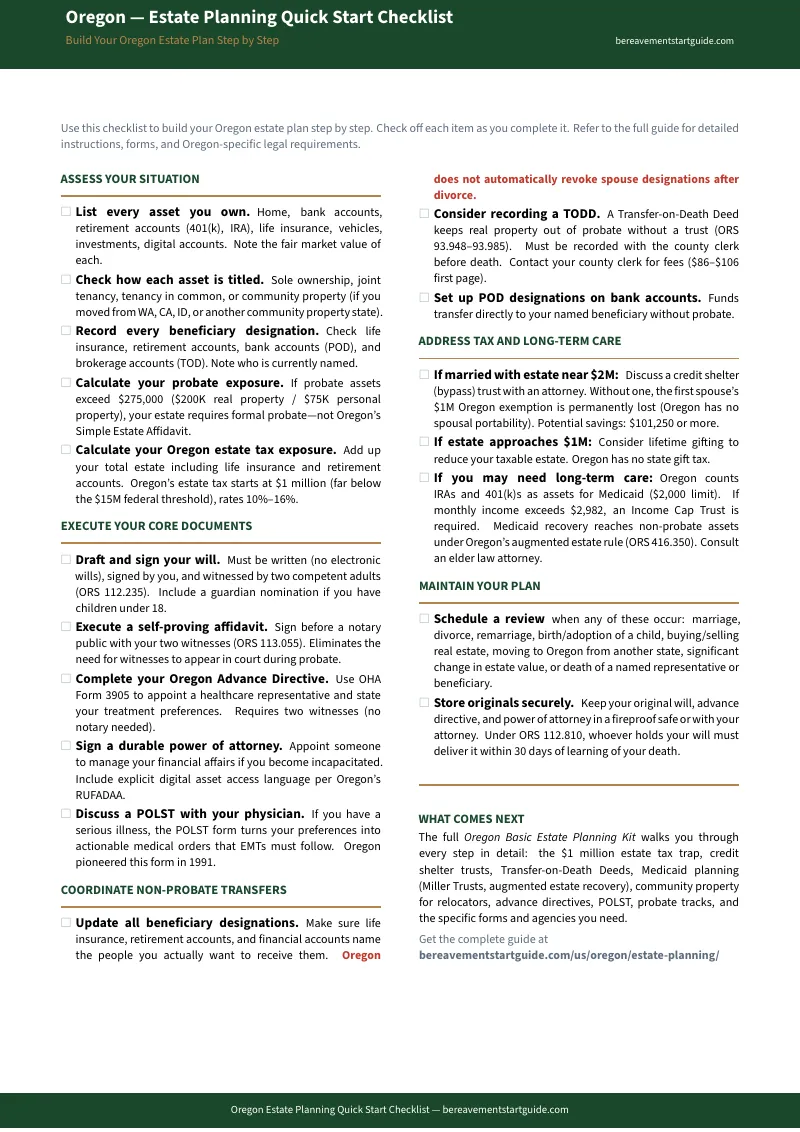
- Oregon Estate Planning Checklist — every document and decision you need to address, in order, with Oregon-specific requirements noted
- Asset Inventory Worksheet — classify every asset as probate or non-probate, with Oregon's small estate thresholds and estate tax exposure checks built in
- Beneficiary Coordination Worksheet — audit all retirement, life insurance, bank POD, investment TOD, vehicle, and digital asset designations against your will
- Estate Tax Worksheet — calculate your exposure to Oregon's $1M non-portable exemption, apply the graduated 10–16% rate table, and evaluate planning strategies
- TODD Recording Checklist — county clerk formatting rules (8.5×14" max, 8-point minimum type), the 18-month creditor claim window under ORS 93.969, and a property tracker
- Medicaid Recovery Reference — Oregon's expanded estate recovery under ORS 416.350, eligibility limits, Income Cap Trust basics, mandatory deferrals, and the $3,500 funeral expense allowance
- Advance Directive & POLST Quick Guide — side-by-side comparison, execution requirements, decision prompts, and a distribution checklist
- Community Property Relocator Worksheet — asset classification for families moving from WA, CA, ID, or other community property states, with action steps to preserve the double step-up in basis
- Forms & Contacts Directory — every official Oregon form, issuing agency, statutory reference, and key threshold on one printable page
Who This Kit Is For
- Oregon homeowners whose property pushes them past the $200,000 real property threshold for simple estate affidavits
- Families with $500K–$2M in assets who need to manage the $1 million estate tax cliff without paying for a complex trust
- Relocators from community property states (WA, CA, ID) who need to protect their tax basis
- Adults over 55 planning around Medicaid estate recovery before a health crisis forces the conversation
- Blended families who need to understand Oregon's spousal elective share and the augmented estate calculation
- Parents of minor children who need guardian nominations and coordinated beneficiary designations
Why Not Just Use Free Forms?
The Oregon Judicial Department provides free probate forms. The Oregon State Bar publishes legal pamphlets. Both are helpful — and both leave you alone at the hardest part.
Court forms are blank PDFs with no context. They don't explain what happens when your will says one thing and your bank account beneficiary designation says another. They don't warn you that recording a Transfer on Death Deed after death invalidates it entirely. They don't mention that Oregon's Medicaid estate recovery program reaches assets that passed outside of probate.
National platforms like Trust & Will ($199–$599) and Nolo ($99+) automate document generation but treat Oregon as a checkbox in a 50-state system. They miss the TODD formatting requirements that trip up county recording offices. They gloss over the community property complications that hit relocators from neighboring states.
This kit fills the gap between raw court forms and expensive software — Oregon-specific, step-by-step, with every requirement tied to the actual statute.
— Less Than a Single Hour of Attorney Time
Oregon estate planning attorneys typically charge $250–$400 per hour. A basic will package runs $1,500 to $3,000. For a fraction of one billable hour, you get a complete system that covers wills, TODDs, advance directives, asset coordination, and tax exposure planning — all built for Oregon law.
Every purchase is backed by a full satisfaction guarantee. If the kit doesn't deliver what you need, let us know and we'll make it right.
Start with the free Oregon Estate Planning Checklist to see what your plan is missing — or grab the full kit to build it from the ground up.