Pennsylvania gave every hospital a list of who decides for you. Your name is not on it.
If you lose the ability to speak for yourself — after a stroke, during emergency surgery, following a car accident — Pennsylvania does not ask your family to negotiate. It assigns decision-making authority to the first available person on a statutory list under 20 Pa. C.S. § 5461: spouse, adult child, parent, sibling, grandchild. In that order. No exceptions.
Your unmarried partner of fifteen years? Not on the list. Your best friend who knows exactly what you want? Ranked below a sibling you have not spoken to since high school. If two adult children disagree on whether to continue life support, the hospital ethics committee takes over — and their deliberations are measured in weeks, not hours.
Meanwhile, Pennsylvania's first-dollar inheritance tax is already creating a financial crisis your family does not see coming. Children pay 4.5%. Siblings pay 12%. Your unmarried partner? 15% — on every dollar, starting from the first one. There is no baseline exemption.
A signed advance directive under Chapter 54 reverses all of this. You choose who decides. You specify which treatments you accept and refuse. You document it before the crisis — and it becomes legally binding the moment two qualified witnesses watch you sign.
The form is free from the Pennsylvania Department of Aging. Executing it correctly is where families fail.
The Pennsylvania Decision-Protection System — Where Free Forms End and Real Planning Begins
Free forms tell you what to fill in. They do not tell you how to avoid the signing errors that silently invalidate your directive, how to coordinate your healthcare POA with your financial POA (different execution requirements, different chapters of the code), how POLST and Out-of-Hospital DNR orders interact with your directive during a home emergency, or how your healthcare decisions connect to Medicaid estate recovery and the inheritance tax exposure your family will face.
The Pennsylvania Advance Directive & Living Will Kit is a Decision-Protection System — the complete operational framework that connects your healthcare directive to every downstream administrative, financial, and clinical decision it affects.
What's Inside the Kit
Chapter 54 Healthcare Directive — Step-by-Step Execution
The statutory requirements for a legally binding healthcare directive in Pennsylvania — two qualified adult witnesses, no notarization required — sound simple until you read the disqualification list. Your healthcare agent cannot witness. Blood relatives, relatives by marriage or adoption, heirs, beneficiaries, creditors, your attending physician, and any employee of your treating facility are all excluded. The kit includes a witness eligibility checklist that prevents the signing errors families discover only during a medical crisis — when the document is useless.
Healthcare POA vs. Financial POA — The Execution Trap
Pennsylvania maintains two entirely separate power of attorney regimes. Your Healthcare POA (Chapter 54) requires two witnesses only — notarization is optional. Your Financial POA (Chapter 56) requires two witnesses AND acknowledgment before a notary public. Families routinely confuse these rules: they skip witnesses for a healthcare directive because they paid for a notary, or they pay unnecessary notary fees for a document that does not require one. The kit maps both execution paths side by side so you complete each document correctly the first time.
POLST, DNR, and Out-of-Hospital DNR Coordination
Your advance directive is a planning document — it tells your agent what you want. But paramedics and EMTs do not follow advance directives during a home emergency. They follow POLST orders (bright pink paper, signed by your physician, designed for people with advanced frailty or serious illness) and Out-of-Hospital DNR orders. A standard hospital DNR does not transfer to your living room. If you want to prevent unwanted CPR at home, you need a separate Out-of-Hospital DNR printed on the official state form and posted in a visible location. The kit explains exactly when each document controls and how to ensure they do not contradict each other.
Medicaid Estate Recovery — Why Your Healthcare Decisions Affect Your Home
Under 55 Pa. Code Chapter 258, Pennsylvania recovers Medicaid costs from the probate estates of recipients who were 55 or older. The critical detail: only assets titled solely in the decedent's name are subject to recovery. If the family home is held as tenancy by the entireties with a spouse, it passes outside probate and is fully exempt. If it is held as tenants in common, the decedent's share is exposed. The kit explains how the caregiver exception works (an adult child who lived in and provided care for two years pre-admission can protect the home), the 45-day claim deadline the state must meet or forfeit, and why healthcare directive planning and asset titling must happen together — not as separate projects.
Inheritance Tax Planning — First-Dollar Exposure
Pennsylvania charges inheritance tax from the first dollar — no exemption threshold. Children and grandchildren pay 4.5%. Siblings pay 12%. Everyone else — including unmarried partners, nieces, nephews, and friends — pays 15%. The kit explains how early coordination between healthcare directives, financial POAs, and asset titling reduces the tax burden and qualifies executors for the 5% early-payment discount. This is the planning context that free forms and national templates never mention.
County-Specific Register of Wills Procedures
Pennsylvania runs 67 separate Register of Wills offices with different fee schedules, electronic filing rules, and Orphans' Court practices. Chester County charges $275 for a filing fee that costs $350 in Westmoreland County. York County mandates electronic filing for petitions but refuses electronic tax returns. The kit maps the variations that matter — so your executor is not blindsided by county-specific requirements after you are gone.
Organ Donation, Dementia Planning, and Revocation
How to integrate organ and tissue donation preferences directly into your Chapter 54 directive. How to draft specific instructions for progressive cognitive decline — early, middle, and late-stage preferences that the standard form's checkboxes cannot capture. How to revoke (written declaration, oral statement, or physical destruction — effective only when communicated to your attending physician). The "5 Ds" review system for keeping your directive current.
8 Standalone Printable Worksheets
Every critical reference extracted as a standalone PDF you can print and use independently — a witness eligibility checklist for your signing ceremony, a Healthcare POA vs. Financial POA comparison card, a POLST/DNR coordination sheet for your refrigerator, a distribution checklist for tracking who receives copies, a Medicaid estate recovery asset worksheet, an inheritance tax quick reference with rates and the 5% discount deadline, a county Register of Wills guide with fee schedules and e-filing rules, and a dementia planning addendum with stage-specific treatment preferences.
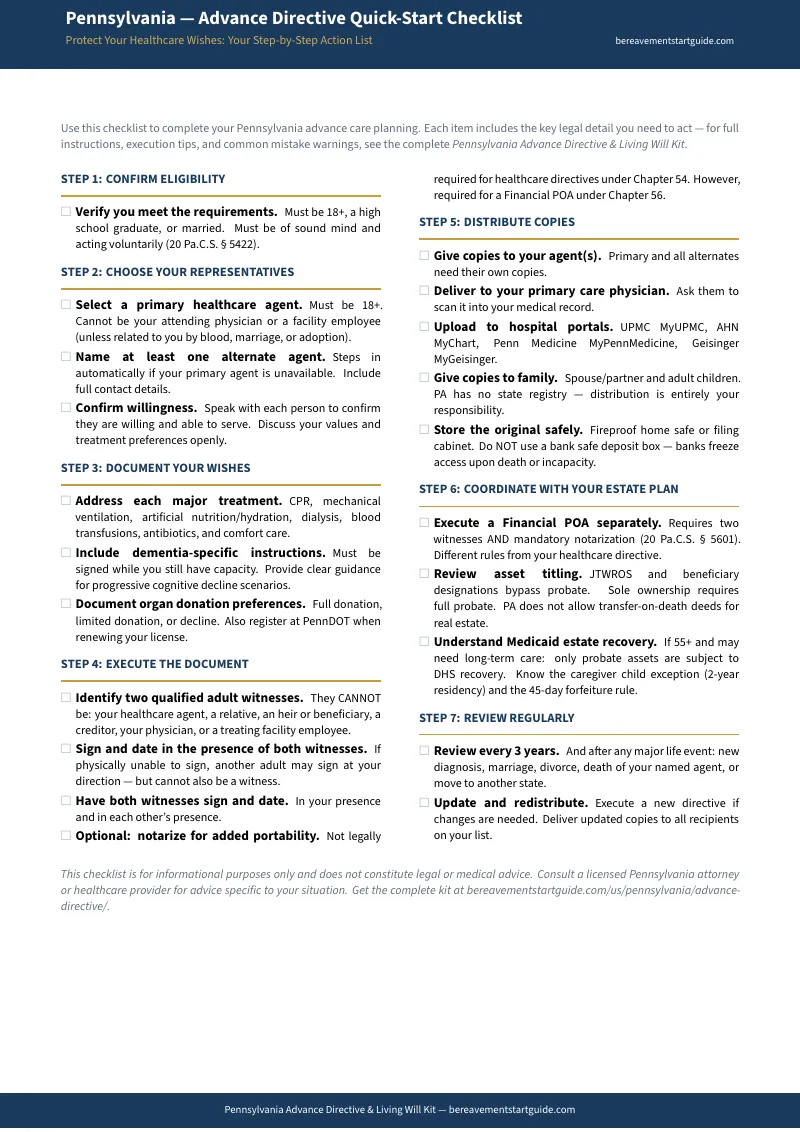
The 20-Item Quick-Start Checklist
A one-page printable reference that walks you through the entire process — from clarifying your values through distributing the signed document. Every critical step at a glance, with page references back to the full guide. Print it, work through it in one afternoon, and know your healthcare wishes are documented and enforceable.
Who This Kit Is For
- The adult child managing aging parents. You need your parents' wishes documented before a diagnosis makes it urgent — and you need to understand the Medicaid estate recovery exposure and your own executor liability if they received benefits.
- The person facing surgery next month. Pre-admission paperwork asks for an advance directive. You need a legally valid Chapter 54 directive completed and distributed before your procedure — not a generic template that may not satisfy Pennsylvania's witness rules.
- The unmarried partner with no legal standing. Pennsylvania's default surrogate hierarchy excludes you entirely. A Chapter 54 directive is the only document that puts you first — and coordinating it with asset titling can reduce the 15% inheritance tax hit your partner would otherwise face.
- The family navigating Medicaid and long-term care. Healthcare planning, asset titling, and Medicaid recovery are one interconnected problem. You need a guide that treats them as such, not three separate documents from three separate sources.
- The proactive planner who downloaded the free form and got stuck. The form is not the problem. The witnessing rules, the POA execution differences, and the downstream tax and recovery implications are.
Why Not Just Use the Free Form?
The Pennsylvania Department of Aging provides a free advance directive template. Hospital networks — UPMC, Allegheny Health Network, Penn Medicine — accept directive uploads through their patient portals. National platforms like LegalZoom and Rocket Lawyer generate multi-state templates for a monthly subscription fee.
None of them explain the Chapter 54 vs. Chapter 56 execution differences. None map how your healthcare decisions connect to Medicaid estate recovery. None cover the first-dollar inheritance tax or the county-by-county Register of Wills variations. None coordinate your advance directive with POLST and Out-of-Hospital DNR orders for home emergencies.
Free tools give you the blank form. National templates insert Pennsylvania's name into a generic framework. An elder law attorney provides all of this — for $1,500–$5,000+ and a multi-week timeline.
The kit bridges the gap: for the complete Pennsylvania-specific execution system that connects your healthcare directive to every downstream decision it affects.
Satisfaction Guarantee
If the kit does not give you everything you need to complete a legally valid Pennsylvania advance directive — from signing through distribution — email hello@bereavementstartguide.com and we will make it right.
Get Started Today
Download the free Pennsylvania Advance Directive Quick-Start Checklist — a one-page reference covering every critical step, witness eligibility rule, and distribution target. It covers the process from start to finish.
When you are ready for the full execution system — the 18-chapter guide with POLST coordination, Medicaid recovery protections, inheritance tax planning, and county-specific procedures — get the complete Pennsylvania Advance Directive & Living Will Kit.
You did not plan to be thinking about this today. But Pennsylvania has already decided who speaks for you if you do not — and it may not be the person you would choose.