You Downloaded the Form. Now What?
South Carolina publishes statutory healthcare directive forms through SCDHHS and hospital networks like Prisma Health and MUSC. The forms are free. The problem is that a single execution mistake — using a witness who's related to you, skipping the notary, or signing in a nursing home without the required state ombudsman — makes the entire document legally void. And you won't find out until the ICU calls your family and nobody has authority to speak for you.
The South Carolina Advance Directive & Living Will Kit is a Witness-Proof Execution System — it takes you from blank form to legally valid, properly witnessed, hospital-distributed directive in a single sitting. No attorney. No subscription. No second attempt because the witnessing was wrong.
— Less Than One Billable Quarter-Hour
South Carolina elder law attorneys charge $250–$1,500 for advance directive and estate planning packages. That's without the witness screening protocol, the ombudsman scheduling instructions, the dementia-specific addendum, or the heirs' property analysis. And the consultation takes weeks to schedule.
The kit covers everything the attorney would — and several things most attorneys don't address — for a one-time fee that's a fraction of a single office visit.
What the Kit Covers
- The Two-Document System Explained — South Carolina's advance directive is actually two separate documents: the Healthcare Power of Attorney under the Adult Health Care Consent Act (S.C. Code §§ 62-5-500 through 62-5-518) and the Declaration of a Desire for a Natural Death under S.C. Code §§ 44-77-10 through 44-77-160. The kit explains how they work together and why having only one leaves a gap
- Witness Screening Protocol — the full disqualification list that trips up most families. Witnesses cannot be related by blood or marriage, cannot be heirs or beneficiaries, cannot be your healthcare agent, and cannot be financially responsible for your care. The kit walks you through screening candidates before you schedule the signing
- Hospital and Nursing Home Ombudsman Rule — if you sign in a hospital or skilled nursing facility, a state-registered Long-Term Care Ombudsman must serve as one of your witnesses. The kit covers how to schedule this, what the ombudsman verifies, and what happens if you skip this step (your directive is void)
- Dementia Planning Addendum — the section standard directives miss entirely. Stage-specific preferences for early, middle, and late cognitive decline: medication compliance, feeding assistance thresholds, hospitalization decisions, and the transition point to comfort-only care
- POLST and EMS DNR Coordination — your advance directive tells your family and doctors what you want. A POST form and EMS DNR order tell paramedics what to do during a home emergency. The kit explains when you need each document, how they interact, and what happens if they conflict
- The Default Surrogate Trap — without an HCPOA, South Carolina's hierarchy requires a majority of your adult children to agree on your care. If two want aggressive treatment and two want comfort care, the hospital freezes your treatment and someone petitions Probate Court to break the tie. The kit helps you bypass this entirely
- Heirs' Property Protection — for Lowcountry families whose land has passed down without probate, the kit covers the partition sale risk, the 10-year probate window, the Heirs' Property Tax Relief Act, and how to coordinate healthcare and property planning before a hurricane season deadline
- Medicaid Estate Recovery Limits — South Carolina restricts Medicaid recovery to assets passing through probate, with a $25,000 threshold and mandatory exemptions for surviving spouses and disabled children. The kit explains how to structure assets so they bypass probate entirely
- Spousal Rights and Elective Share — the one-third elective share, the omitted spouse petition, and the $45,000 exempt personal property claim that protects a surviving spouse's essentials from estate creditors
- Document Distribution and Storage System — who gets copies, where to file originals, the South Carolina eRegistry, and the wallet card that ensures first responders know your directive exists during an emergency
Standalone Printable Worksheets
In addition to the 15-chapter guide and quick-start checklist, the kit includes 8 standalone worksheets and reference sheets you can print and use independently:
- Witness Screening Worksheet — run each potential witness through the disqualification rules before scheduling the signing
- Document Distribution Tracker — track who received copies of your HCPOA, Living Will, and POST form
- Dementia Planning Worksheet — stage-by-stage care preferences to attach to your HCPOA
- Forms & Contacts Reference — every form, agency, phone number, and cost on one printable page
- Asset Protection Worksheet — inventory your probate exposure and Medicaid recovery risk
- Surrogate Hierarchy Reference — the default decision-making hierarchy and why an HCPOA overrides it
- Probate Quick Reference — timeline, costs, and steps for each probate track
- Spousal Rights Reference — elective share, exempt property, and omitted spouse deadlines
Who This Is For
- Adults helping aging parents who need a legally valid directive completed before a health crisis or cognitive decline removes the option — and need to know how to start that conversation
- Anyone facing scheduled surgery who needs executed healthcare documents before the pre-op appointment and wants to avoid the hospital's rushed intake paperwork
- Unmarried and LGBTQ+ partners who have zero default medical decision-making authority under South Carolina's surrogate hierarchy and need to override it before an emergency reveals the gap
- Caregivers navigating nursing home admissions who need to understand the ombudsman witnessing requirement and Medicaid asset protection before they schedule a signing
- Lowcountry families with heirs' property who need to coordinate healthcare planning with property protection before partition sale risks or hurricane season deadlines
- Anyone who downloaded the free form and got stuck on the witness disqualification rules, the notary requirements, or the question of how to handle tube-feeding directives
Why Not Just Use the Free Form?
The statutory forms from SCDHHS and hospital networks are technically complete. But they ship with zero execution guidance. No witness screening protocol. No ombudsman scheduling instructions. No explanation of how the HCPOA interacts with the Living Will or when you need a POLST on top of both. No dementia planning addendum. No asset protection analysis.
National platforms like LegalZoom, Five Wishes, and Trust & Will charge more and deliver less — generic multi-state templates that don't address South Carolina's ombudsman mandate, the Adult Health Care Consent Act's majority-rule default, or the Lowcountry's heirs' property crisis. They give you a form. The kit gives you the execution system that makes the form legally bulletproof.
The Guarantee
If your physician, hospital network, nursing facility, or notary public rejects the instructions in this kit for any compliance reason, email us for an immediate, no-questions-asked refund.
Start Today
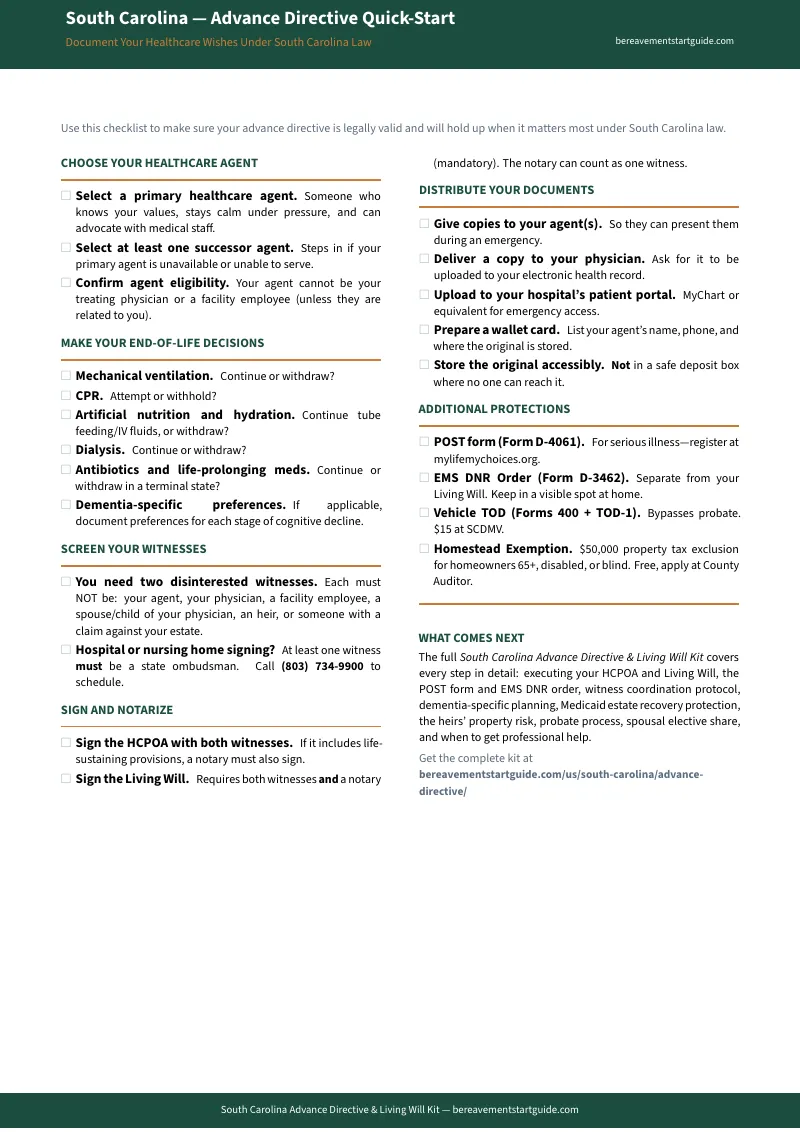
Download the free South Carolina Advance Directive Quick-Start Checklist to see every action item at a glance. When you're ready for the full execution system — the 15-chapter guide covering healthcare power of attorney, living will, witness protocol, dementia planning, POLST/DNR coordination, heirs' property protection, Medicaid limits, and spousal rights — the complete kit is available for .
Disclaimer: Bereavement Start Guide is a publisher of self-help educational templates and resource guides. The materials in this kit are designed to comply with South Carolina statutory law but do not constitute legal or medical advice. For complex estate planning, contested family dynamics, or specific medical instructions, consult a licensed South Carolina attorney or healthcare provider.